The Welcomers


When Marjorie Silverman became a concierge, it was unusual.

Back when Marjorie entered our field, most people didn’t know what a concierge was, much less how to pronounce the word… What she did was a big deal. Our international organization was very male and European-dominated, so she single-handedly broke that glass ceiling.

What does a concierge do? Her Chicago Tribune obituary explains:

Silverman’s workdays typically started with a meeting of luggage attendants to advise them of the arrivals and departures, particularly of large groups. She would also check the VIP arrival list and send those guests a note or, when appropriate, a gift. As business travelers left for appointments, she made travel arrangements and arranged baby-sitting services, dinner and theater reservations. Then she began preparing for the next wave of guests.

In short, a concierge upholds one of humanity’s oldest and noblest traditions, hospitality. The details have changed over millennia, but the essence remains the same:

When a stranger came to the house, he was always entertained with a warm bath for his “poor feet” and with food and wine. He was never (vide Homer’s poems) rudely, or even civilly, questioned as to his name, country, and business, until his bodily wants had been attended to. It was not, indeed, until the cloth was removed, the dessert put upon the table, and the wine-cup passed around, that the questions were put: Who are you? Whence come you? What is your city?

– A Few Reflections on the Rights, Duties, Obligations and Advantages of Hospitality, Cornelius Walford, 1885


Toni Mascolo, an Italian immigrant to the UK, opened a hair salon with his brother in London in the 1960s. Over the next half-century, they created an international chain in 48 countries.

As Mascolo’s Financial Times obituary notes, Toni & Guy’s success was in part due to historic good timing:

During the “swinging Sixties” models and pop stars set new style trends. London became a fashion capital. Women began entering the workplace and they spent some of their earnings on haircuts and beauty treatments. More recently men have begun to take more care of their appearance as well.

But the success was also due to listening. As his Wall Street Journal obituary recounts, “Women began asking if the salon could cut their husbands’ or sons’ locks, so the brothers turned their shop into a pioneering unisex establishment.”

Listening wasn’t just good business sense; Mascolo understood it was an obligation – and advantage – of hospitality.

“He had a tremendously strong set of values and passed them on to the staff. He said you had to treat clients as if you are inviting them into your home.”


Henry Saglio

Image result for steaming dutch oven

In the 1920s, supporters of Herbert Hoover claimed he’d bring about such prosperity that America would have a chicken in every pot.

That would have raised the living standard of the average American family, even in the Roaring Twenties. As this article explains, “a chicken dinner was such a rare treat that the few chickens raised for meat were sold directly to high-end restaurants, first-class dining cars, and luxury caterers.”

Chicken is now the most commonly eaten meat in the United States. This transformation is in large part due to the ingenuity of a man Frank Perdue called “the father of the chicken industry.”


https://www.ers.usda.gov/webdocs/charts/62884/meat-availability.png?v=42394


Henry Saglio began breeding chickens as a teenager. His initial motivation was the respite it provided from farming in the open sun. Within decades, as his Boston Globe obituary notes, “three out of four birds sold were descended from Mr. Saglio’s breed stock.”

Mr. Saglio, who had only an eighth-grade education, took his expertise to the developing world as well, and, at the age of 87, founded a company dedicated to antibiotic-free breeding.

“I’ve dedicated my life to making chickens affordable to poor people,” Saglio told Associated Press in 1987. “And that’s what I did. Everybody’s eating chicken now.”


Continue reading “Henry Saglio”

Riskers

The Private

Emmanuel Mensah, a Ghanaian immigrant, was a National Guardsman. Although not on duty two weeks ago, he remained true to his vocation.

“He brought four people out. When he went to bring a fifth person out, the fire caught up with him.”

The Philosopher

Anne Dufourmantelle was at the beach last summer when she saw two children struggling in the water. She went in to rescue them, dying in the effort. She probably had a sense of the risk involved, as she was a student of the concept:

“We say in French ‘to risk one’s life,’ but perhaps we should say ‘to risk being alive.’ To be truly alive is a risk few take.”

The Bank Examiner

Twenty minutes after the crash, the sun was going down, and no one had been able to reach the six survivors. They were doomed… until suddenly, miraculously, a rescue chopper came whisking across the darkening sky. It dropped a life ring right into the hands of one of the survivors and plucked him from the water. Then things turned really strange.

The next person to receive the ring handed it over to someone else. The chopper lofted her to safety, then wheeled back.

The man gave away the ring again.

And again.

Arland D. Williams, Jr. was on a business trip when his flight crashed into the icy Potomac River. Until that moment he was, according to this profile, “a man whose life was a monument to playing it safe.” Williams helped five fellow passengers to safety before he went down with the plane.


A Christmas Memory


On December 6, 1917, two ships collided near the shore of Halifax, Nova Scotia. One, filled with munitions for the Western Front, caught fire. Most of the city’s inhabitants were unaware of their mortal danger.

Vince Coleman, a train dispatcher, saw that calamity was imminent, and delayed his own evacuation so that he could warn inbound trains to halt. He and two thousand others perished in one of history’s largest explosions.


The city of Boston responded quickly. Abraham Ratshesky, a banker, public servant, and philanthropist, led the way:

Ratshesky mobilized that first “relief special,” getting the workers out of Boston on the night of December 6. The group was so determined to reach Halifax that its members climbed out of the train in the snowstorm to help shovel the tracks.

In gratitude for Boston’s help, every year the province of Nova Scotia sends the Hub its official Christmas tree.


The Doctor, the Submariner & the Cook


Image result for viktor zhdanov

In 1958, a Soviet virologist proposed that all countries work together to end smallpox.  As this tribute notes, “no disease had ever been eradicated. No one knew if it could even be done.”

In 1977, the last case was found in Somalia.

Smallpox is the only human disease to have been eradicated. Thanks to what Viktor Zhdanov started, efforts to end polio, malaria, and several other diseases are now underway.


Image result for underwater nuclear explosion


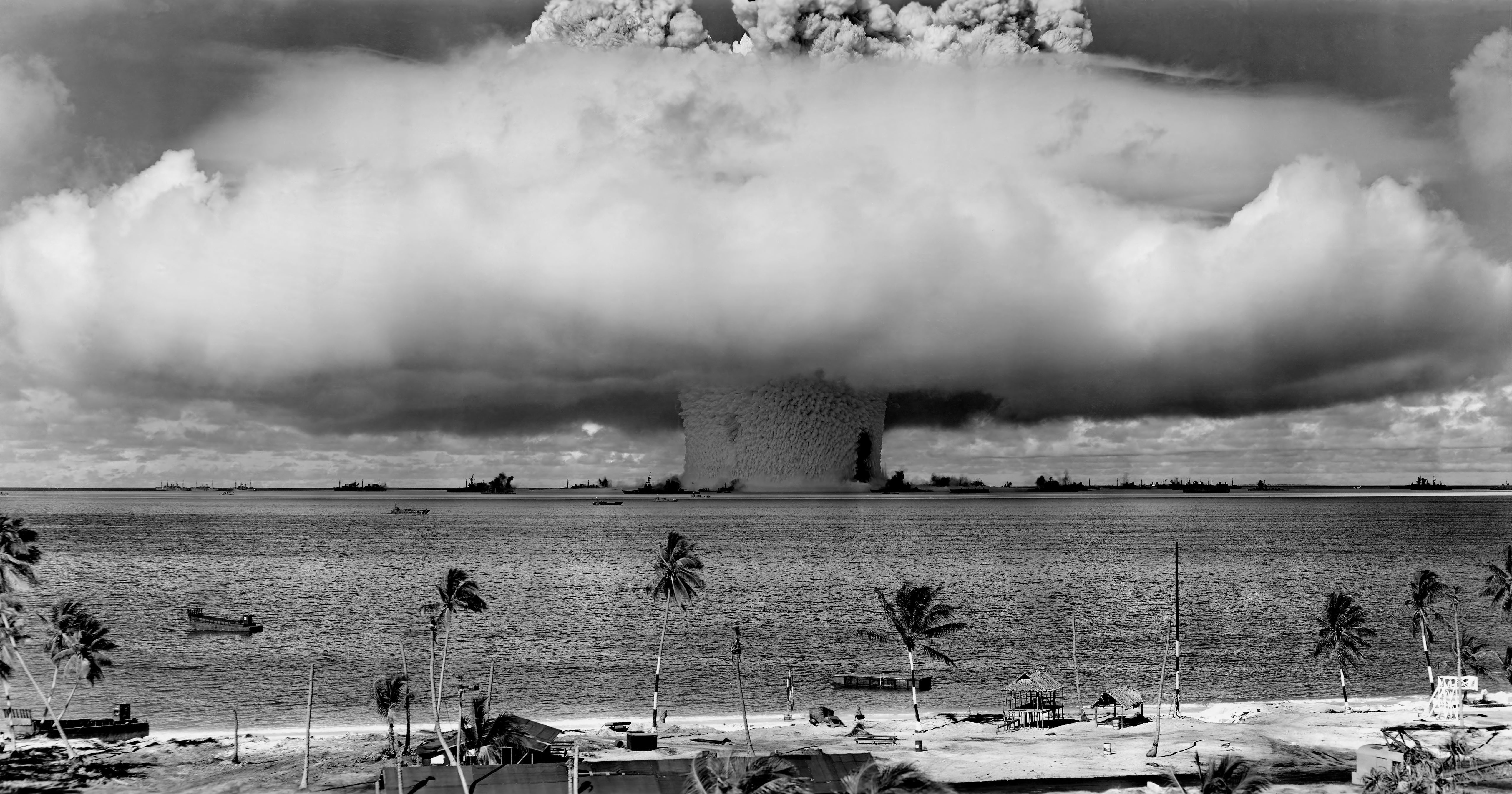
During the Cuban Missile Crisis, a US warship began to fire warning shots at a Soviet submarine. Unfortunately, only the Americans knew it was a warning.

The submarine’s officers, out of radio contact with Moscow, assumed that war had begun and prepared to launch their nuclear weapon. It was only the second-in-command’s reasoned refusal that prevented “a cascade of destruction.”

Many years later, the director of the National Security Archive concluded: “The lesson from this is that a guy called Vasili Arkhipov saved the world.”


One of the lives Mr. Arkhipov probably saved was that of Ali Moaw Maalin, a cook in a Somali hospital. He also worked part-time as a smallpox vaccinator. Unbeknownst to his colleagues, he himself had declined to be vaccinated, for fear it would hurt. He thus earned his place in history as the last smallpox patient.

Upon being cured, he resolved to put his own experience to good use in polio eradication campaigns:

Now when I meet parents who refuse to give their children the polio vaccine, I tell them my story. I tell them how important these vaccines are. I tell them not to do something foolish like me.

In 2013, he succumbed to malaria while continuing Dr. Zhdanov’s magnificent endeavor.